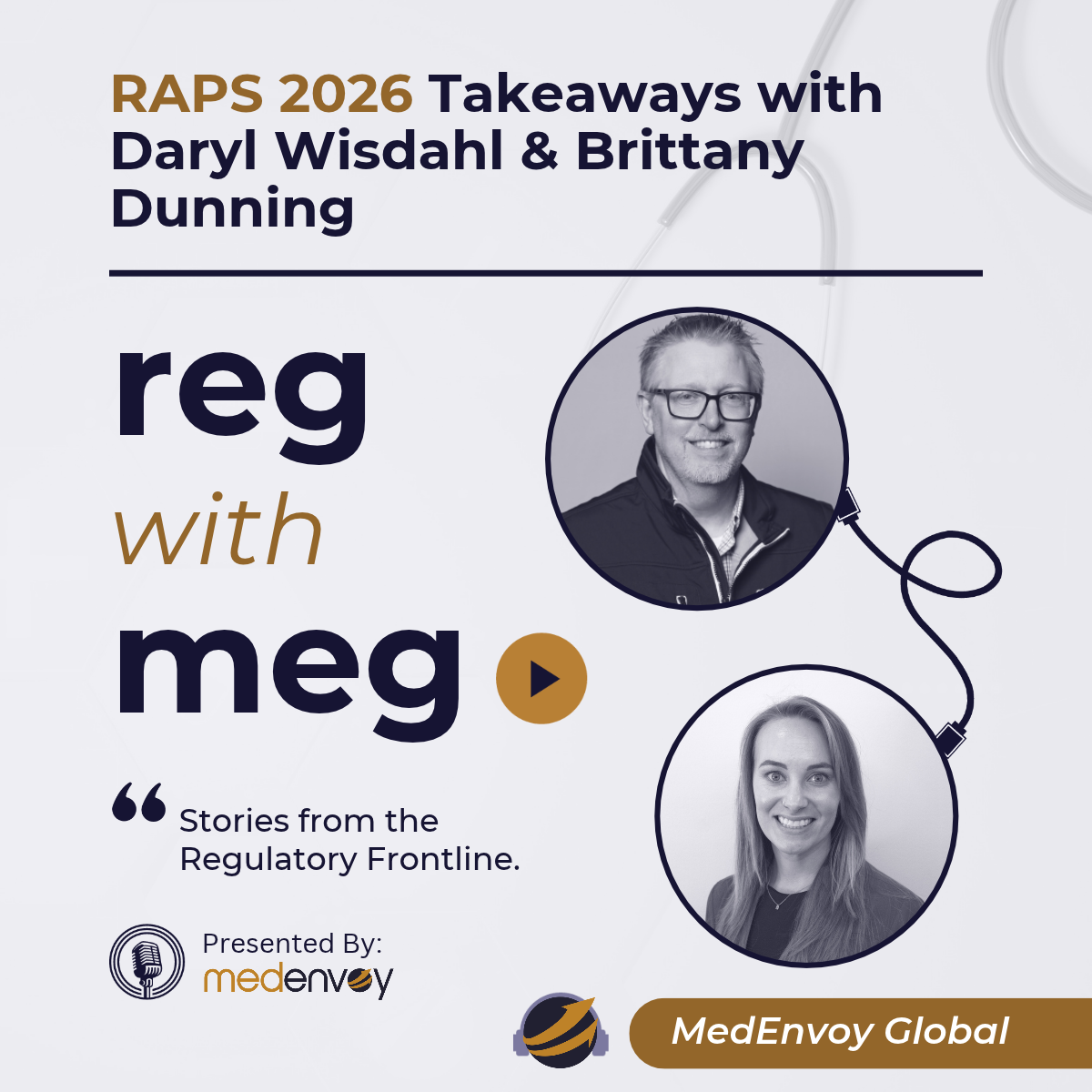
A valid CE certificate and a clean audit history do not guarantee that a shipment clears the border.
Why the Technical File Is Not the Whole Compliance Picture
Most of the scrutiny in a regulatory program lands on the technical file. Notified bodies review it, internal auditors question it, and customers ask about it. The legal actors underneath it, such as the authorized representative, importer, and distributor who register, import, and distribute the product, are rarely audited, often because no procedure says who owns them.
In this episode of Reg with MEG, Daryl Wisdahl, Director of Consulting Services at MedEnvoy, and Brittany Dunning, Senior Regulatory Affairs and Operations Consultant at MedEnvoy, join Tiffany Brown to share their takeaways from RAPS Convergence 2026 in Charlotte, North Carolina, and to walk through their presentation, “Your Dossier Is Fine. Your Economic Operators Aren’t.” The conversation covers the topics that dominated the event, the four ways post-approval compliance quietly falls apart, the warning signs that a representative relationship is not working, and a simple check manufacturers can run on their own.
Check out the full episode below:
Key Takeaways from This Episode
- The dossier gets audited. The economic operators usually do not. Notified bodies, internal auditors, and customers examine the technical documentation file. The entities that register, import, and distribute the product are rarely examined, typically because no procedure assigns ownership. Daryl’s framing is that this is an ownership problem, not a knowledge problem, and one a team can start fixing right away.
- Failure mode 1: the mismatch. The device label, the national registration, and the notified body certificate each name the authorized representative, and they can drift apart for structural reasons. Regulatory owns some of these documents, marketing often updates labeling artwork, a local third party may hold the registration, and the certificate can change at each renewal. Nothing forces anyone to compare them when something small changes.
- Failure mode 2: the thin mandate. Representative agreements are often negotiated as part of a commercial contract, with regulatory obligations added late as an appendix. One of the most common gaps is a missing termination or handover clause, so nothing is written about what happens when the relationship ends.
- Failure mode 3: the handover. Changing an authorized representative is more than signing a new agreement. Notice periods, custody of the documentation, the registration record, device labeling, and notification of importers and distributors all have to be handled, mostly in sequence. Brittany and Daryl’s point is that this takes months, not weeks.
- Failure mode 4: registration does not end with EUDAMED. EUDAMED is a strong traceability database, but it is not a compliance program, and it does not cover Switzerland or Great Britain. Some EU member states also require additional national steps, with Spain and Italy given as examples.
- Warning signs do not require an audit. Ask a few people to name your representative in a given market and see how long it takes and whether the answers match. Check whether a key contact has left their role, at your company or at the representative. Notice whether you hear about regulatory developments from a distributor or a conference instead of your representative. And ask when someone last read the agreement, not just signed it, since device scope may not have kept pace with the portfolio.
- Treat representatives like qualified suppliers. Daryl recommends applying the supplier qualification discipline that ISO 13485 organizations already use: walk through each obligation and who does what, ask for proof rather than confirmation (a registration number and date, the approved labeling artwork), and send a test query down the correspondence path before an event such as a vigilance report makes it urgent.
- A three-column reconciliation is the first step. Compare what the label says, what the local registration says, and what the certificate says. Name an owner, name a backup, and repeat it at least once a year. The control is the owner, not the tool. In one audience example, a manufacturer’s updated label did not match its import documents, and Brittany suggested a traceability matrix and a live import file with a label placeholder, checked before each shipment. As Daryl put it, the technical file proves the device is compliant, and the economic operator proves the market is compliant.
- RAPS 2026 was more focused than 2025. Daryl and Brittany described conversations centered on what is changing: the proposed simplification of the EU MDR and IVDR, the transferability of clinical data across regions, and product data governance. Their point was that simplification does not remove national registrations, representative mandates, or importer relationships, which sit underneath it.
Listen to the Full Episode
Brittany and Daryl walk through each of these in more detail, including the questions they received after the session. Listen to the full conversation on Spotify or YouTube. The slides from their presentation are available and as well as the check list can be downloaded here.
If you have questions about your authorized representative, importer, or registration setup, contact MedEnvoy’s team of regulatory experts, or learn more about our in-country representation services.
SHOW NOTES
A valid CE certificate and a clean audit history do not always prevent a stuck shipment. Daryl Wisdahl, Director of Consulting Services at MedEnvoy Global, and Brittany Dunning, Senior Regulatory Affairs and Operations Consultant, join Tiffany Brown to share their takeaways from RAPS Convergence 2026, explain why they presented on economic operator compliance, and walk through four ways post-approval compliance quietly falls apart.
In this episode:
- 00:00 Welcome and introduction
- 00:41 Overall impressions of RAPS Convergence 2026 in Charlotte
- 02:29 The biggest regulatory topics and trends at the event
- 08:28 Why Daryl and Brittany chose this presentation topic
- 11:29 Four ways post-approval compliance falls apart: the mismatch
- 13:22 The thin mandate and missing handover clauses
- 14:45 What it takes to change authorized representatives
- 17:13 Why EUDAMED registration is not the finish line
- 19:16 Warning signs your economic operator relationship is not working
- 22:23 How to confirm economic operators are fulfilling their responsibilities
- 25:04 Audience reactions and questions
- 28:11 How Charlotte compared with Pittsburgh
- 31:52 The one thing to review in your economic operator strategy
MedEnvoy Global is an ISO 13485 certified regulatory compliance partner supporting medical device, IVD, and cosmetics manufacturers entering international markets. We provide in-country representation, regulatory importer services, and RA/QA consulting across the EU, UK, Switzerland, US, and markets throughout LATAM, the Middle East, and Asia-Pacific.
Talk to our team: https://medenvoyglobal.com/talk-to-an-expert/
Related Guidance
We share our expertise because we believe in removing barriers to global commercialization.
Webinar | IVDD to IVDR: Mind the Gap Before You Apply
DNV and MedEnvoy present a one-hour webinar on 9 December 2026 on the IVDD to IVDR transition for Class B and Class A sterile IVD manufacturers preparing for the 2027 milestones.

How Much Does It Cost to Register a Medical Device with the FDA in 2027?
FDA fees for medical device registration depend on classification. The FY 2027 annual establishment registration fee is $13,785, plus pathway fees for 510(k), De Novo, and PMA submissions.

AI at RAPS 2026: Where Regulators and Industry Agree. Recap with Rocio Fallas
AI was among the most discussed topics at RAPS Convergence 2026. Rocio Fallas shares her impression of where regulators and industry agree, and what manufacturers should prepare for in 2027.