
For US medical device manufacturers considering non-US markets, understanding the influence of North America’s dominant medical device landscape and global regulatory requirements for medical devices is crucial. Responsible for approximately 50% of the estimated USD 578.75 billion global medical device market in 2024, North America continues to dominate the medical device landscape. (source). This dominance makes market entry in the US a high priority for device manufacturers, particularly those based in the US. However, increasing global harmonization efforts are lowering regulatory barriers for market entry, creating opportunities for US device manufacturers to expand into other markets. In this article, we explore markets where such opportunities exist and discuss strategies for minimizing the associated regulatory burden. Additionally, we provide a brief overview of reimbursement systems in select non-US markets that merit attention from US-based manufacturers.
Non-US markets recommended for consideration by US manufacturers can be grouped into three categories, including:
- Markets where US marketing authorization/approval can be leveraged for local marketing authorization/approval, such as Australia.
- Markets where US marketing authorization/approval provides avenues for accelerated local marketing authorization/approval, such as Singapore.
- Markets where being a US-based manufacturer allows for accelerated Quality Management System certification, as part of the requirements for device registration such as Taiwan.
In the case of Australia, CE marking was historically the most common pathway to obtaining device listing on the Australian Register of Therapeutic Goods (ARTG). However, as founding members of the International Medical Device Regulators Forum (IMDRF), both Australia and the US were instrumental in developing the Medical Device Single Audit Program (MDSAP). Consequently, MDSAP Certification (with Australia within scope), combined with appropriate evidence of FDA marketing authorization/approval, can now be leveraged for ARTG listing.
In the case of Singapore, the US FDA is recognized by the Singapore Health Sciences Authority (HSA) as an overseas reference regulatory agency. Manufacturers that have obtained marketing authorization/approval from one or more overseas reference regulatory agencies may be eligible for immediate registration or for the abridged or expedited evaluation pathways. Eligible devices benefit from lower fees compared to those applicable under full evaluation submissions, along with reduced review timeframes and documentation requirements.
Eligibility on these alternative evaluation pathways is described in current HSA guidance.
In the case of Taiwan, US-based manufacturers are eligible for a simplified Quality System Documentation (QSD) certification review process. QSD certification is required for the majority of imported devices. Eligibility of US-based manufacturers for a simplified QSD review requires the manufacturer to be able to present the following:
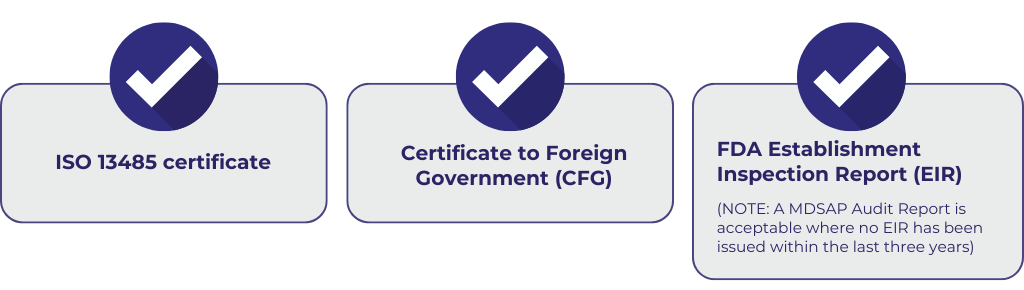
The Certificate to Foreign Government (CFG) can be found here.
Other non-US markets that don’t fall into any of the above categories include markets with significantly different regulatory requirements or higher regulatory burdens, particularly for medium-to-high risk medical devices, such as China and the European Union.
When assessing regulatory burdens on a global scale, US medical device manufacturers are advised to consider the following strategies to minimize the impact.
QMS Requirements
While ISO 13485 certification continues to provide the broadest global coverage for demonstrating compliance with QMS requirements, MDSAP certification has, in recent years, become a viable alternative. This is particularly useful in jurisdictions where ISO 13485 certification cannot be leveraged, including the five founding members of the IMDRF (Australia, Brazil, Canada, Japan, and the USA).
Device Design and Manufacturing Requirements
For US-based manufacturers committed to CE certification under the MDR/IVDR, particularly those whose devices require Notified Body involvement, such certification can also facilitate entry into other markets, including Australia, Singapore, and Taiwan. In the case of Australia, over the last several years, the Therapeutic Goods Administration (TGA) has made significant strides in aligning the Essential Principles established under Schedule 1 of the Therapeutic Goods (Medical Devices) Regulations 2002 with those under the MDR/IVDR. Brazil has also moved toward aligning its regulatory framework with EU requirements, including the establishment of Essential Requirements for in vitro diagnostic medical devices (IVDs) in Resolution RDC 848/2024. However, national product certification requirements, such as INMETRO certification for active devices and ANATEL certification for devices with wireless communication capabilities, continue to exist. It is recommended that small-to-mid-size manufacturers leverage technical documentation—particularly product certification testing—as much as possible when considering global market entry.
Regulatory Change Frequency, Nature, and Complexity
This consideration requires a degree of regulatory awareness and intelligence from the manufacturer, as there is significant disparity between global regulators regarding the frequency, nature, and complexity of regulatory changes. Unfortunately, market maturity no longer appears to be a reliable measure for assessing these characteristics of regulatory change, with the EU being a case in point. Despite the MDR/IVDR being published over seven years ago, manufacturers continue to struggle with obtaining CE certification where Notified Bodies are involved. As of October 21, 2024, the European Parliament published the Joint Motion for a Resolution on the Urgent Need to Revise the Medical Devices Regulation. This resolution calls for the European Commission to propose implementing acts to the MDR/IVDR, as well as a systematic revision of all articles of these regulations by the end of the first quarter of 2025, to address significant issues raised because of these regulations.
Additionally, other regulators, such as ANVISA in Brazil, are well-known for periodically implementing significant changes to their regulatory frameworks. Foreign manufacturers, including those in the US, who heavily rely on Brazilian registration holders (BRHs) for awareness of these changes—especially since they are only available in Brazilian Portuguese—often remain unaware of these updates due to poor communication with their BRHs.
Reimbursement Frameworks in Global Markets
While there have been global efforts towards harmonizing global markets for US medical device regulatory requirements, no such harmonization exists for reimbursement frameworks, which vary significantly between countries. This variation is largely due to differences in overarching healthcare systems, particularly regarding health insurance. Consequently, it is strongly recommended that manufacturers assess reimbursement as part of evaluating the commercial viability of specific markets, as it is a critical aspect of a device’s commercial success.
For example, in Australia, medical devices are reimbursed at rates according to their inclusion on the Prescribed List (formerly the Prostheses List), while IVDs are covered by the Pharmaceutical Benefits Scheme (PBS). Although the Department of Health and Aged Care has made significant progress in addressing issues with the process of adding devices to the Prescribed List, there continues to be a lack of transparency in the assignment of coverage values to devices.
Innovative Reimbursement Models for Digital Health and Nursing Applications
In contrast, other markets have developed innovative reimbursement models for specific types of devices. A prime example of this approach is Germany, where, at the end of 2019, the Digital Healthcare Act came into effect, introducing the “app on prescription” model as part of healthcare provided to patients. Under this act, reimbursable digital health applications listed on the Digital Health Applications (DiGA) directory, following a successful Federal Institute of Drugs and Medical Devices (BfArM) assessment, can be prescribed by physicians and psychotherapists. Eligibility for inclusion in the DiGA directory requires the digital application to possess the following qualities:
-
- Class I or IIa medical device according to the MDR (or MDD as part of the transition regulations)
-
- The main function of the DiGA is based on digital technologies
-
- The DiGA is not a digital application that serves only for the collection of data from a device or for controlling a device and the medical purpose must be achieved through the main digital functions
-
- The DiGA supports the recognition, monitoring, treatment or alleviation of diseases or the recognition, treatment or alleviation or compensation of injuries or disabilities
-
- The DiGA does not serve primary prevention
-
- The DiGA is used only by the patient or by the patient and the healthcare provider, meaning that apps that are only used by the physician to treat patients (practice equipment) are not a DiGA
In addition to DiGA, Germany has also established a reimbursement framework for Digital Nursing Applications (DiPA). Eligible devices must undergo a successful BfArM assessment for inclusion on the DiPA directory and possess the following properties:
-
- A DiPA can, but does not have to, be a medical device. However, if it is a medical device, it must comply with the MDR or MDD (under the transition regulations) and belong to a low-risk class (Class I or IIa).
-
- The main function of the DiPA is based on digital technologies.
-
- The nursing benefit is determined by the DiPA and (if applicable) the DiPA-required supplementary support services (eUL). However, a DiPA is not a digital application solely for collecting data from a device or for controlling a device.
-
- The DiPA serves the purpose of reducing the impairment of independence or abilities of the person in need of care or counteracting the aggravation of the need for care, thus resulting in nursing benefits.
-
- The DiPA can be used independently by those in need of care or in interaction with relatives, other voluntary caregivers, and approved nursing or care provider services.
-
- The DiPA can also support caring relatives or other voluntary caregivers in caring for those in need of care or managing household tasks. However, the prerequisite is that the DiPA serves to stabilize the home care situation for those in need of care.
-
- The DiPA is intended solely to support those in need of care in the home context.
MedEnvoy’s regulatory experts can assist in a variety of global markets in helping with regulatory requirements for US medical device manufacturers. Please reach out if you need assistance by clicking here. For more information about our regulatory experts, click here.