
SFDA Issues Dedicated Bundling Guidance for Medical Device and IVD Marketing Authorization Applications
The Saudi Food and Drug Authority (SFDA) published MDS-G28: Bundling Criteria for Medical Devices Marketing Authorization (Version 1.0) in May 2026, replacing the bundling criteria previously set out in Annex 12 of MDS-G5 and Annex 15 of MDS-REQ1. With MDS-G28 now in effect, manufacturers with Medical Device Marketing Authorization (MDMA) registrations in Saudi Arabia, or those planning to submit new applications, should review what has changed, particularly for surgical and dental instruments, procedure packs, and IVD products.
Insights on MDS-G28
MDS-G28 is not a minor update. Previously, bundling criteria were covered in just four pages within the much larger MDS-G5 guidance document. The SFDA has replaced that section with a dedicated 17-page document focused entirely on bundling, issued under the Medical Devices Law and its Implementing Regulation. It introduces two new product categories for bundling, overhauls the rules for IVD products, and adds new required documents for procedure packs.
For surgical and dental instrument manufacturers, the new sub-categories are a meaningful change. Surgical instruments no longer need to share the same intended use, they just need to perform the same function. This matters for manufacturers with large product lines that previously needed separate applications simply because devices served different clinical purposes while doing the same basic job. The new dental instruments sub-category creates a clear bundling path based on dental specialty, which did not exist before.
The IVD changes are the most significant in the document. Removing the design and manufacturing process requirement makes it easier to bundle some products, but the new seven-category grouping system adds a new rule: IVDs must now share the same category, not just the same principle of operation. Manufacturers with IVD products that fall across more than one diagnostic category should check each product against the new categories before assuming existing bundled applications are still valid. For manufacturers of reagents and consumables, the Class A exemption for general laboratory supplies is a real benefit, as long as those products actually qualify.
Key Changes at a Glance
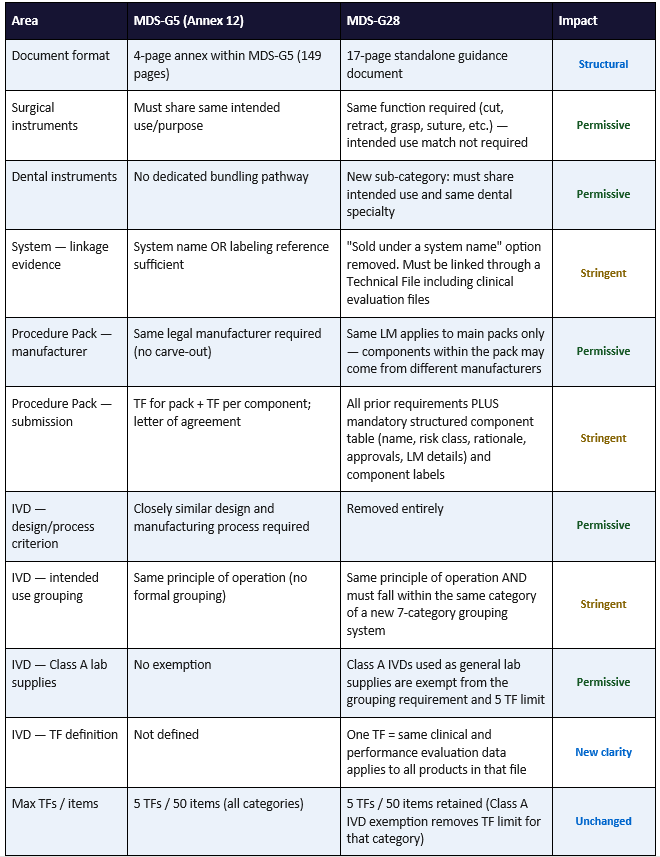
Key Changes in MDS-G28
Medical Device Families
The standard Family bundling rules remain in place (same manufacturer, intended use, risk class, GMDN code, physical design and manufacturing process, maximum five Technical Files, and maximum 50 items). MDS-G28 adds two new sub-categories:
- Surgical instruments (Section 1.1) — devices no longer need to share the same intended use. Instead, they must share the same function: cutting/incising, retracting, grasping, dilating, cannulating, aspirating, or suturing. Common construction material and manufacturing process are still required.
- Dental instruments (Section 1.2) — a brand new sub-category. Devices must share the same intended use and fall within the same dental specialty. The list of specialties includes General Dentistry, Oral Surgery, Orthodontics, Endodontics, Dental Implantology, and six others.
- Standalone products and sets — a standalone product cannot be bundled with a set or kit in the same application, even if that product is one of the set’s components.
- Accessories — if an accessory is itself a medical device and is labelled for use with a specific device, it must be submitted under the System rules, not as part of a Family application.
Medical Device System
The core system bundling rules are unchanged (same manufacturer, combined use for a common purpose, one system per application, highest risk class applies, maximum five TFs and 50 items). One significant change affects how a system must be documented:
- Technical File linkage now required — previously, a system could qualify simply by being sold under a system name. That option has been removed. The system must now be supported by a Technical File that clearly links all components, including labels, IFU, brochures, catalogues, and clinical evaluation documents, and states they are intended to be used together.
Procedure Pack
The core rules are unchanged (same intended use and specialty, same risk class for packs, maximum five TFs, 50 items). MDS-G28 introduces two new requirements:
- Manufacturer carve-out — the same legal manufacturer rule now applies only to the main packs. Components inside the pack can come from different manufacturers.
- Mandatory component table — a formal letter must now be submitted that lists each component’s name, SFDA risk class, the reason for that classification, any existing approvals, the intended use, and the legal manufacturer’s name and address. Component labels must also be included. This was not required before.
IVD Medical Devices
The IVD section sees the biggest changes in MDS-G28. The same manufacturer, same risk class, and the five TF / 50 item limits still apply. The following rules have changed:
- Design and manufacturing process requirement removed — IVDs no longer need to have a closely similar design and manufacturing process to be bundled together.
- New seven-category grouping system — bundled IVDs must now fall within the same category: Blood Grouping, Tissue Typing, Cancer/Tumor Markers, Human Genetic Testing, Infection/Immune Status Markers, Non-Infectious Pathologies and Physiological Markers, or Controls without Assigned Value. Products from different categories cannot be bundled.
- Class A exemption for general laboratory supplies — Class A IVDs used as specimen containers, dyes and stains, culture media and broth, general-purpose reagents (such as fixatives, buffers, and preservatives), tissue processing equipment, or cell and tissue culture supplies are exempt from the grouping requirement and the five TF limit. Blood specimen collection devices, laboratory machinery, and automated or powered systems do not qualify for this exemption.
- Technical File definition clarified — a group of products counts as one Technical File only when the same clinical and performance evaluation data covers every product in that file. Examples include respiratory virus panels tested at the same time, drugs of abuse panels, or assayed controls bundled with their assay kit.
What This Means for Manufacturers
In addition to reviewing the new guidance as it applies to planned registrations, it is important to also review existing MDMA registrations and the Technical Files submitted, to ensure no updates to bundling will need to be made when the license is up for renewal.
- Surgical and dental instrument families — check whether products that previously needed separate applications now qualify under the new function-based or specialty-based categories.
- Medical Device Systems — confirm that your Technical File covers all system components, clearly links them for combined use, and includes clinical evaluation documents. A system name on labeling alone is no longer enough.
- Procedure packs — build the new mandatory component table into your submission process before the next application or renewal. Make sure component risk classifications and manufacturer details are already documented and easy to pull together.
- IVD portfolios — check each IVD product against the seven categories and confirm that all products in a bundled application fall within the same one. Where they do not, plan for separate submissions.
- Class A IVD lab supplies — confirm your products actually qualify for the exemption before building a submission around it. Blood specimen collection devices, laboratory machinery, and powered systems are excluded.
How MedEnvoy Can Support
MedEnvoy supports medical device and IVD manufacturers marketing in Saudi Arabia with regulatory strategy, authorized representation, and MDMA application management. We can help you assess how this new bundling criteria affects your existing registrations and planned applications, review your Technical File documentation, and identify anything that needs to be updated.
If you would like to discuss how these changes apply to your product portfolio, connect with our regulatory experts. Learn more about MedEnvoy’s Saudi Arabia regulatory and authorized representative services.
Related Guidance
We share our expertise because we believe in removing barriers to global commercialization.
Webinar | IVDD to IVDR: Mind the Gap Before You Apply
DNV and MedEnvoy present a one-hour webinar on 9 December 2026 on the IVDD to IVDR transition for Class B and Class A sterile IVD manufacturers preparing for the 2027 milestones.

How Much Does It Cost to Register a Medical Device with the FDA in 2027?
FDA fees for medical device registration depend on classification. The FY 2027 annual establishment registration fee is $13,785, plus pathway fees for 510(k), De Novo, and PMA submissions.

AI at RAPS 2026: Where Regulators and Industry Agree. Recap with Rocio Fallas
AI was among the most discussed topics at RAPS Convergence 2026. Rocio Fallas shares her impression of where regulators and industry agree, and what manufacturers should prepare for in 2027.