
Australia’s Prescribed List: Reimbursement and Application Tiers
9 mins
Home » Resources & News » Australia’s Prescribed List: Reimbursement and Application Tiers
In a previous article (available here), we provided an overview of Australia’s Prescribed List, the medical device reimbursement process formerly known as the Prostheses List. The Prescribed List (PL), as it is now known, requires private health insurers to pay benefits for products as listed.
Medical Device Reimbursements and Application Tiers Regarding Australia’s Prescribed List
The previous article included an outline of the changes to reimbursement benefits enacted by the Australian government to reduce ballooning benefit costs. With the recent guidance published in July 2024, “Prescribed List of Medical Devices and Human Tissue Products Guide – Draft,” we want to provide further details on the updates to medical device reimbursement in Australia.
Are you a manufacturer trying to place a medical device on the Australian market? MedEnvoy can assist you. Click here, for more information.
Stakeholders in the Australia’s Prescribed List Scheme
While some stakeholders on the Prostheses List continue to play a role in the PL scheme, there are some newcomers. These include:
Australian Sponsor: This is the same entity responsible for submitting applications to the TGA for inclusion of devices on the Australian Register of Therapeutic Goods (ARTG). Regarding the PL scheme, the Sponsor is responsible for submitting PL applications for new devices or amendments to existing billing codes using the Health Products Portal (HPP) and providing all information to inform the assessment and decision-making process.
Minister of Health and Aged Care: Responsible for administration of the Private Health Insurance (PHI) Act and making decisions on whether to list a device on the PL or amend the existing billing codes and whether conditions are to be placed on the billing code.
Expert Clinical Advisory Groups (ECAGs): Responsible for assessing the clinical functions and comparative clinical effectiveness of medical devices being considered for listing on the PL in the applications submitted through the Tier 2 and Tier 3 pathway (NOTE: There are currently six ECAGs, e.g. Spinal and Neurosurgical ECAG (SNECAG)).
Medical Devices and Human Tissue Advisory Committee (MDHTAC): MDHTAC comprises a Chair + 6 x ECAG Chairs + 2 x independent members with expertise in medical technology with are not members of any ECAG + 1 x consumer member. The MDHTAC makes recommendations to the Minister of Health and Aged Care and advises the Department of Health and Aged Care about the suitability of products for PL listing, and their associated benefits, or amendments to the details of the existing billing codes, or any other post-listing activities as required. Despite the regulatory reforms enacted, deliberations and recommendations made by the MDHTAC recorded in minutes and its sub-committees continue to be considered commercial-in-confidence.
Health Technology Assessment (HTA) Groups: These groups may be engaged when clinical effectiveness and/or cost-effectiveness assessment of the device is necessary.
Medical Services Advisory Committee (MSAC): MSAC is responsible for providing advice to the government on whether a medical service health technology or program should be publicly funded under the Medicare Benefit Scheme (MBS) or another program. Where a full HTA is required (for applications under the Tier 3 pathway), an application must also be made to MSAC. MSAC oversees the HTA process and provides advice to MDHTAC and the Department of Health and Aged Care that informs assessment of relevant PL applications.
Department of Health and Aged Care: This government department is responsible for several aspects of the PL scheme, including:
-
- Undertaking departmental assessments and providing advice to sponsors (all Tiers)
- Working with ECAGs on the clinical assessments for Tier 2 and Tier 3
- Commissioning HTA for Tier 2 when required and working with MSAC on Tier 3 applications
- Working with and providing support to the MDHTAC in making recommendations
- Providing recommendations and making decisions on listing the products, amending the existing billing codes, and setting up benefits as required
- Making the legislative instruments (the Rules) and maintaining the PL
- Maintaining the HPP (enabling access for sponsors, external assessors, and departmental staff)
- Administering PL cost-recovery arrangements
- Developing and implementing policy on private health insurance funding of medical devices and products
- Updating guidance material and relevant legislation as required
- Providing advice to and facilitating discussions with sponsors and other stakeholders about the PL arrangements
- Commissioning, coordinating, and/or undertaking post-listing reviews when required
- Maintaining and providing advice on the compliance, assurance, and enforcement principles and provisions to support the effective administration of the PL compliance capability
Australia’s Prescribed List Product Groupings
Within each of the product categories (mentioned in our previous article), the Department of Health and Aged Care has established different product groupings to facilitate the identification of appropriate comparators for benefit determination purposes. The grouping code assigned is among the information listed in the PL for included devices. For example, the Cardiac category includes the following groupings for single-chamber implantable cardioverter-defibrillators (ICDs):
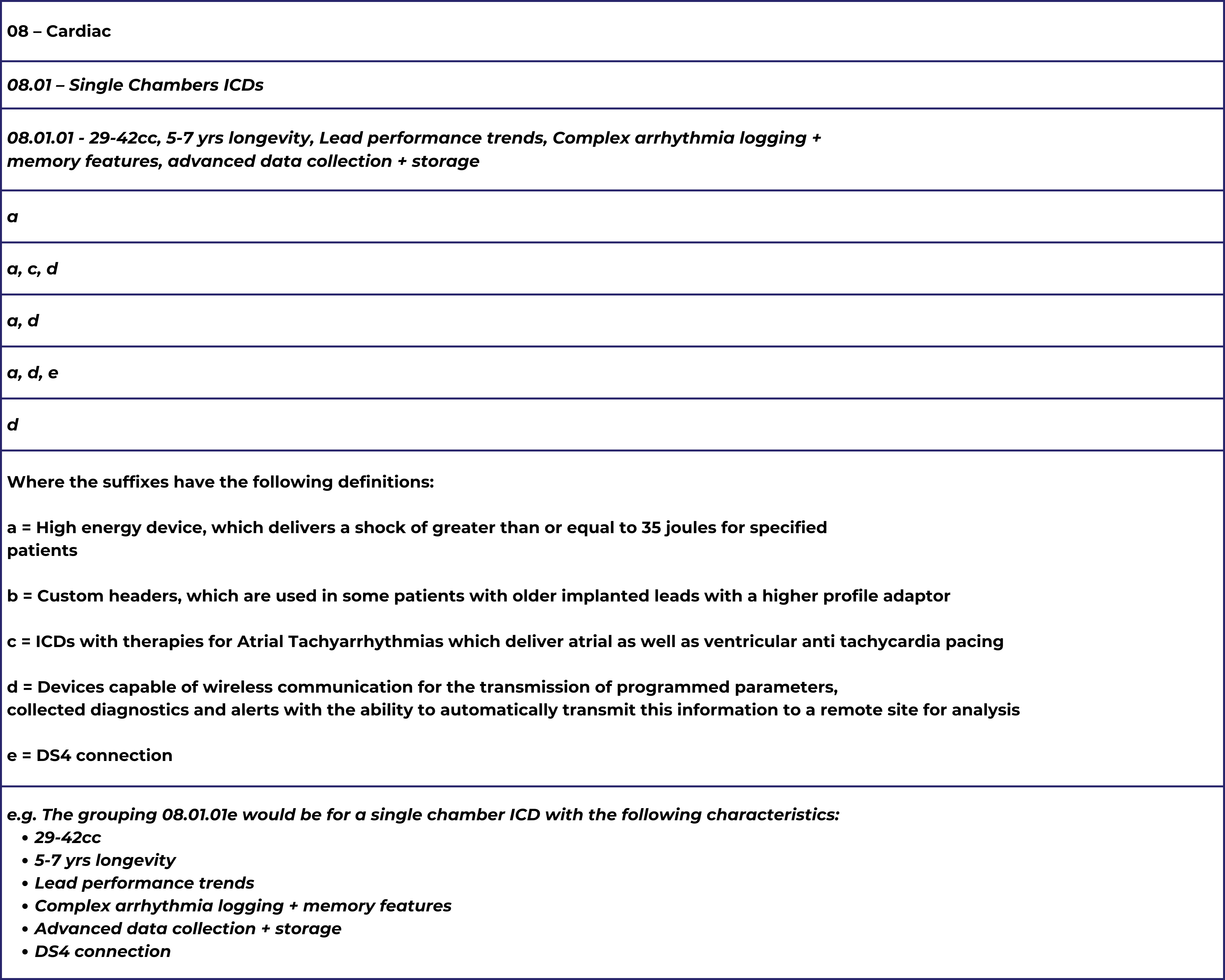
However, it should also be noted that as part of its regulatory reforms, the Department of Health and Aged Care is revising product groups. The current groupings are available here, but they still refer to the Prostheses List.
Australia’s Prescribed List Application Tiers
As mentioned in our previous article, three types of applications may be submitted under the PL Scheme, after the inclusion of the device on the ARTG or submission of an application for device inclusion on the ARTG, including:
Tier 1 – Department Assessment Pathway
Applications submitted under this pathway are assessed only by the Department of Health and Aged and Care. The baseline requirements for this pathway are that the medical devices are:
-
- Class IIb or lower
- Well-established technology (with relatively simple, well-understood, and stable designs and limited variations, and with proven records of satisfactory safety and performance)
Furthermore, it is expected that devices assessed under this pathway will be interchangeable with the comparator devices listed in the same PL grouping, i.e.
-
- Similar characteristics
- Intended for use in the established patient population with the same indications
- It is unlikely that the device will cause an increase in the PL expenditure within the group
All claims of interchangeability with the comparator stated in the application must be justified. Sponsors may only apply for listing the device in one of the existing PL groupings and do not ask to change the groupings for the billing codes in the amendment applications.
This pathway does not apply to the following types of devices:
-
- Class III devices
- Devices within scope of Part C of the PL
- Devices subject to PL Part A applications for which the comparators are currently listed on the PL with conditions applied (as indicated in Part A of the PL)
Manufacturers must be aware that there is only a single opportunity under this pathway to provide sufficient information if the Department determines that the application is incomplete, has incomplete information, or the subject device is ineligible. If the manufacturer is unable to address the Department’s concerns in this single response, they will need to wait until at least the next cycle to submit another application (the PL is updated 3 times a year, in March, July, and November) and the device is no longer eligible for the Tier 1 pathway.
Tier 2 Clinical/Focused HTA Pathway
This tier pathway is for devices not suitable for assessment via the Tier 1 Pathway and require clinical assessment by the respective Expert Clinical Advisory Group (ECAG), and in some cases HTA consulting group. Specifically, devices within the scope of this pathway include:
-
- Class III devices
- Devices within scope of Part C of the PL
- Devices within scope of Part A of the PL of any risk classification that is not well-established technology, i.e. Devices which:
- Are reasonably new/do not have a long history
- Have known issues with performance/safety problems
- Have high variability in design and characteristics
- Have novel features, characteristics, or functionality
Additionally, the following types of applications are subject to the Tier 2 pathway:
-
- Requests for a new or amended grouping
- Applications rejected under the Tier 1 pathway, including where the sponsor was unable to provide the required information in the format required by the Department.
The pathway has two routes dependent upon the level of assessment required:
-
- Tier 2a – Clinical assessment only
- Tier 2b – Clinical assessment + Economic assessment to establish cost-effectiveness
Under the Tier 2b route, an HTA may be undertaken by a HTA Group assigned by the Department which will typically take the form of a focused commentary (appraisal) of the clinical and/or economic claims made by the sponsor in the application. Sponsors are provided the opportunity to provide feedback on the assessment reports before them being provided to MDHTAC.
Tier 3 – Full HTA Pathway
This pathway is for devices requiring assessment by the MSAC to establish the comparative clinical effectiveness and cost-effectiveness and, in some cases, assessment of the device is conducted as part of the assessment of the related Medicare service (NOTE: Medicare is the Australian public healthcare system). The PL application may be submitted concurrently with or after the MSAC application. Applications and the respective correspondence must identify and explain the link between the PL application and the MSAC application.
Examples of applications that are subject to the Tier 3 pathway include:
-
- Devices for which there is no relevant MBS item associated with the use of the device (a new or amended MBS item is necessary)
- Novel devices or first-in-class technology and/or there are no appropriate comparators on the PL
- Listing the device on the PL will likely cause a significant financial impact on the overall PL expenditure, thereby warranting a detailed financial assessment.
Specific Clinical Data Requirements
The drafted Australia Prescribed List Guide that was published to assist Sponsors in preparing their applications for the July 2024 Prescribed List is available here. This includes guidance on specific clinical data requirements where such data is necessary (Tier 2 and 3 applications). For example, this guidance includes the following requirements for knee and hip devices:
-
- For hip and knee joint replacement devices used in primary or in both primary and revision procedures, the clinical data is required on a minimum of 250 procedures with at least 2 years of adequate follow-up
- For hip and knee joint replacement devices, used in revision or special circumstances or unusual situation devices (e.g. constrained acetabular cup designed for use in high risk of dislocation patients) procedures, the clinical data is expected on a minimum of 50 hip or knee joint replacement devices implanted with at least 2 years follow-up
- For the tumor devices, a minimum of 20 devices implanted with at least 2 years of follow-up may be accepted, although these devices may have variability in the data requirements depending on circumstances.
While this guidance is still in draft, it provides highly specific detailed clinical data requirements that manufacturers should consider when designing their clinical investigations.
Learn More about Australia’s Prescribed List with MedEnvoy
This article provides an overview of updates to medical device reimbursement under the Australia’s Prescribed List scheme. Should you have any questions regarding Australian medical device regulatory requirements, or require an Australian Sponsor, get in touch.
Related Resources



Related Guidance
We share our expertise because we believe in removing barriers to global commercialization.

8 mins
EU Classification Guidance Updated: Borderline Manual and MDCG 2021-24
The European Commission published two closely related guidance updates that directly affect how medical devices and in vitro diagnostic medical devices are qualified…

14 mins
The Business Impact of EUDAMED on Market Access
The European Database on Medical Devices (EUDAMED) is often viewed by manufacturers purely as a compliance burden when…

2 mins
MedEnvoy at RAPS Euro Convergence 2026
We are excited to share that MedEnvoy will be participating in RAPS Euro Convergence 2026 as an exhibitor! This year’s…