
The medical device industry continues to grow and evolve, becoming increasingly reliant on technology, making software a crucial component of product development, manufacturing, and operations. This includes AI and machine learning in Software as a Medical Device (SaMD).
Learn more about MedEnvoy’s regulatory compliance consulting services by clicking here.
Software that controls or influences a medical device has become more prevalent. At least three different types of software are considered to be medical devices:
-
- Software that is an integral part of the medical device (software in a medical device)
-
- Software used to manufacture or maintenance a medical device
-
- Software that itself is a medical device
The International Medical Device Regulators Forum (IMDRF) defines a SaMD as “software intended to be used for one or more medical purposes that perform these purposes without being part of a hardware medical device.” Examples of SaMDs include:
-
- Treatment planning software
-
- Diagnostic software
-
- MRI Software
-
- Smartphone (vital monitoring)
-
- Computed tomography
-
- Digital pathology
-
- Medical Device Integration Software
FDA and IMDRF Guidelines for AI and Machine Learning in SaMD
The FDA is developing a framework related to AI and Machine Learning based SaMD to ensure efficacy and safety. The FDA’s focus is on the risk to users and patients resulting from software use. Additionally, under the new framework, any changes to the software would require premarket submission to the FDA when:
-
- The AI and Machine Learning SaMD modification significantly affects the performance of the device
-
- Impacts the efficacy or safety
-
- Modifies the intended use
-
- A major change to the SaMD algorithm
If an AI or Machine Learning SaMD has already undergone successful Premarket Approval (PMA), then such changes would require a supplemental application instead. Several AI and Machine Learning based SaMDs have been approved by the FDA to date; however, these devices were approved with a “locked” algorithm prior to being placed on the market. The nature of an AI or Machine Learning SaMD, however, is for the algorithm to improve over time based on use and real-world information. Therefore, in this case, any change in the algorithm would necessitate a new premarket application.
The International Medical Regulators Forum’s (IMDRF) position on SaMD is a risk-based approach that takes into consideration the intended use, similar to the FDA’s approach. In the EU, SaMD is also categorized based on risk and may be classified either on its own or in combination with another device/component. The guidance documents published by the EU will also begin to focus on medical device software with AI and Machine Learning driven capabilities and functionalities.
Under the IMDRF framework, two major factors should be considered when classifying the intended use of AI and Machine Learning based SaMD:
1. Significance of information: The SaMD provides information that influences healthcare decisions, such as enabling treatment or diagnosis or driving clinical management.
2. State of the healthcare situation or condition: This includes identifying the disease or condition and the intended target population of the SaMD, such as for use in critical care situations or for monitoring daily vitals of a generally healthy person through a fitness application on their phone.
In addition, these intended use situations are considered and the AI and Machine Learning based SaMD is then categorized into one of the four (4) risk categories:

It is important to ensure that an AI and Machine Learning SaMD is classified appropriately for its intended market and use. Additionally, the classification will determine the level of submission required. The entire lifecycle of anAI and Machine Learning SaMD should be considered when developing and validating the device. The FDA provides an example of this workflow which can be found here.
Ensuring a Quality Management System Evaluation in SaMD
When developing and maintaining an AI and Machine Learning based SaMD, manufacturers need to ensure that their quality management system (QMS) is set up to support appropriate design and development, verification and validation, clinical and/or performance evaluation, and post-market surveillance. This is especially important for these device types, as they introduce additional requirements that traditional medical devices do not have.
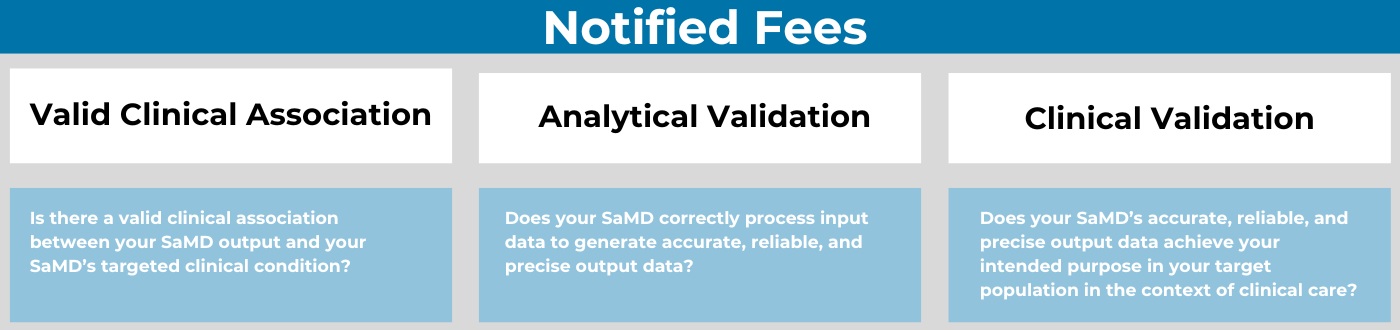
When considering the clinical evaluation of an AI and Machine Learning based SaMD, the IMDRF provides guidance on the best clinical evaluation approach:
Good Machine Learning Practices with AI and Machine Learning
In addition, good machine learning practices (GMLP) should be considered during the design and development of an AI and Machine Learning based SaMD. These considerations include:
-
- Data management: Relevance of available data to the clinical problem and current clinical practice.
- Feature extraction: Data acquired in a consistent, clinically relevant, and generalizable manner that aligns with the SaMD’s intended use and modification plans.
- Training: Separation between training, tuning, and test datasets.
- Evaluation: Transparency (clarity) of the output and the algorithm aimed at users.
Learn More About AI and Machine Learning SaMDs with MedEnvoy
It is important for manufacturers of AI and Machine Learning based SaMDs to consider best practices related to accessibility, data management, reusability, and algorithm controls. Given the enhanced capabilities and intended increase in functionality, the protocols implemented to ensure compliance and manage post-market experiences should be developed in accordance with available guidance and regulations, while also addressing data protection and security concerns. AI and Machine Learning based SaMD continues to grow, providing promising advancements in patient care and positive clinical outcomes. Continued guidance on clinical pathways and validation will evolve. MedEnvoy can assist your organization in complying with regulations concerning SaMD and developing appropriate, risk-based approaches for these devices. Please reach out if you need assistance by clicking here, and for information about our regulatory experts, click here.
Related Resources
This article is one of a series in which our key regulatory experts curated based on themes at RAPS Convergence 2024. To read the full series, click here.



Related Guidance
We share our expertise because we believe in removing barriers to global commercialization.

Swissmedic Launches 2026 PMS Focus Campaign for Higher-Risk Medical Devices
Swissmedic has issued a formal information letter announcing that it will conduct a focus campaign in 2026 reviewing…

TGA Clarifies Exclusion for Digital Mental Health Software
The Australian Therapeutic Goods Administration (TGA) published guidance on 16 March 2026 clarifying when software products intended…
FDA Reclassifies Two Skin Cancer Diagnostic Devices
The Food and Drug Administration (FDA) issued a final order on March 25, 2026 reclassifying two types of…