On May 19, COFEPRIS published an updated medical device labeling standard, NOM-137-SSA1-2025, in the official Diario Oficial de la Federación (DOF). The update replaces NOM-137-SSA1-2008 and marks a significant shift in approach: from a minimum label content framework to a comprehensive system that integrates labeling, traceability, and risk communication. The new standard will enter into force 360 calendar days after publication (May 14, 2027) and allows an additional 180 calendar days (November 10, 2027) to deplete inventories of packaging made under the prior scheme.
Insights on NOM-137-SSA1-2025
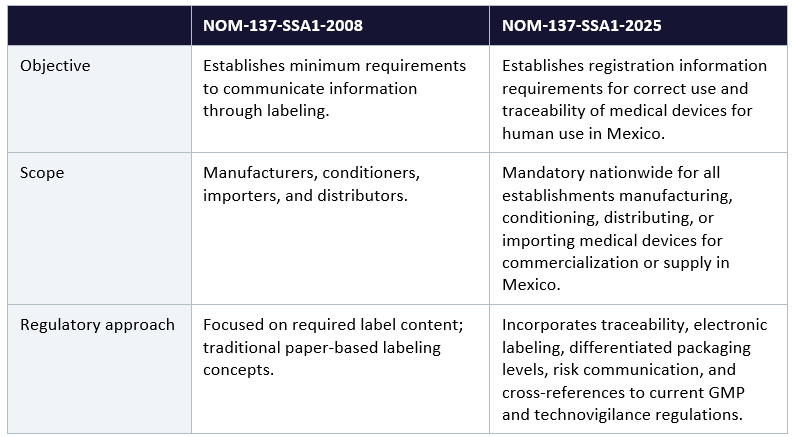
It is important to note that this is not a routine revision. The 2025 standard restructures the regulatory expectations for medical device labeling in Mexico in ways that go beyond format or presentation. It explicitly links labeling to traceability, risk management, and technovigilance, and introduces requirements for electronic labeling, software as a medical device (SaMD), and a standardized symbol library. Manufacturers selling or registering devices in Mexico should treat this as a substantive compliance update, not an administrative one.
Key updates include a broadened objective that adds traceability and correct use to the standard’s scope, a significantly expanded definitions section aligned with current regulatory frameworks, explicit recognition of electronic labeling, a normative symbol appendix covering 70 graphic symbols, and direct cross-references to Mexico’s updated technovigilance and GMP standards.
What Has Changed: 2008 vs. 2025
Expanded Scope and Definitions
The 2025 standard introduces a significantly more extensive definitions section, updated to reflect current regulatory concepts and international frameworks. New definitions include accessories, self-testing IVDs, secondary labels, contraindications, consumables, analytical and clinical performance, and single-use devices. The broader device definition and expanded vocabulary align the standard more closely with contemporary global labeling expectations and Mexico’s updated regulatory architecture.
Key Labeling Requirements
The 2025 standard specifies that labeling must enable identification of the device, the manufacturer, and the technical description, and must communicate the intended purpose, conditions of use, maintenance, storage, residual risks, warnings, limitations, and contraindications. The general labeling set must include:
- Device name or denomination
- Manufacturer or legal manufacturer name and address
- Lot or serial number
- Manufacturing date and expiration date, where applicable
- Storage conditions
- Instructions for use and indications for use
- Country of manufacture
- Sanitary registration number
Electronic Labeling Now Recognized
The 2025 standard formally recognizes electronic labeling, defined as content supplied through an accessible electronic pathway, including QR codes and barcode-linked elements. This opens the door for manufacturers to supplement or replace traditional paper-based labeling with electronic formats, subject to accessibility requirements. Manufacturers should assess whether electronic labeling represents a viable compliance or optimization strategy for their product lines.
Risk Communication Requirements
The standard now expressly requires that labeling communicate residual risks, warnings, limitations, and contraindications. Formal definitions for ‘advertencia’ (warning) and ‘contraindicación’ (contraindication) are included in the definitions section, reinforcing that risk communication is a structured regulatory obligation, not discretionary content.
Standardized Symbol Library
NOM-137-SSA1-2025 includes a normative Appendix A establishing a standardized library of 70 graphic symbols for medical device labeling. Symbols span manufacturer identity, sterility, storage, safe use, IVD-specific requirements, infusion and transfusion, and patient information. Manufacturers must confirm their existing symbol sets are consistent with the new normative requirements.
Software as a Medical Device (SaMD)
The 2025 standard explicitly addresses SaMD as part of its differentiated labeling requirements. Manufacturers of software-based medical devices should review whether their current labeling meets the specific requirements introduced for this product category.
Alignment With Current Mexican Regulations
The 2025 version expressly cross-references NOM-008-SE-2021, NOM-050-SCFI-2004, NOM-072-SSA1-2012, NOM-240-SSA1-2012 on technovigilance and NOM-241-SSA1-2025 on GMP for medical devices, as well as relevant editions of the Mexican Pharmacopoeia. This is a clear signal that labeling compliance in Mexico is now formally linked to post-market surveillance, manufacturing quality, and current device guidance, not treated in isolation.
Transitional Timeline
- Publication date: May 19, 2026
- Entry into force: May 14, 2027 (360 calendar days after publication)
- Inventory depletion deadline: November 10, 2027 (an additional 180 calendar days to deplete packaging produced under NOM-137-SSA1-2008)
Manufacturers should factor both dates into their labeling transition planning. The inventory depletion period provides limited additional runway and is not a substitute for early compliance preparation.
What This Means for Manufacturers
NOM-137-SSA1-2025 raises the baseline for medical device labeling in Mexico. The standard now encompasses traceability, risk communication, electronic labeling, and SaMD-specific requirements that did not exist or were not formalized under the 2008 version. Manufacturers with existing COFEPRIS registrations or active product lines in Mexico should act now rather than wait for the 2027 deadline.
- Conduct a labeling gap assessment against the 2025 requirements, covering all packaging levels, IFUs, and accompanying documentation.
- Review traceability and identification elements to confirm they meet the updated standard’s requirements for lot/serial numbering, manufacturer identification, and sanitary registration.
- Evaluate risk communication content — warnings, contraindications, and residual risk statements — against the new formal definitions and requirements.
- Assess electronic labeling options and determine whether QR or barcode-based labeling is appropriate or advantageous for your product lines.
- Confirm symbol compliance against the normative Appendix A symbol library.
- Review SaMD-specific requirements if your portfolio includes software-based medical devices.
How MedEnvoy Can Support
MedEnvoy monitors regulatory developments across global medical device markets as part of our ongoing regulatory intelligence service. We share updates of this nature because labeling non-compliance is one of the most common sources of registration delays and post-market enforcement actions, and transitions of this scale require early planning.
Our regulatory team will assess how NOM-137-SSA1-2025 applies to your product portfolio, identify gaps between your current labeling and the updated requirements, and support you in developing a compliant transition strategy ahead of the May 2027 deadline.
If you have questions about this update or its implications for your products in Mexico, contact us here.
Related Guidance
We share our expertise because we believe in removing barriers to global commercialization.
COFEPRIS Finalizes Medical Device Labeling Standard
On May 19, COFEPRIS published an updated medical device labeling standard, NOM-137-SSA1-2025, in the official Diario Oficial de la Federación (DOF). The update replaces…

Swissmedic Launches 2026 PMS Focus Campaign for Higher-Risk Medical Devices
Swissmedic has issued a formal information letter announcing that it will conduct a focus campaign in 2026 reviewing…

TGA Clarifies Exclusion for Digital Mental Health Software
The Australian Therapeutic Goods Administration (TGA) published guidance on 16 March 2026 clarifying when software products intended…