
The Medical Device Coordination Group (MDCG) has published MDCG 2025-8, a comprehensive guidance document on the implementation of Master UDI-DI for spectacle frames, spectacle lenses, and ready-to-wear reading spectacles. This guidance supports manufacturers in meeting the requirements introduced under Commission Delegated Regulation (EU) 2025/1920, which amends the Medical Device Regulation (MDR) with specific provisions for highly individualized devices.
As a highly individualized product category, spectacles and their components vary widely in design parameters, materials, and patient-specific configurations. The introduction of the Master UDI-DI aims to enhance traceability, improve regulatory consistency, and facilitate effective vigilance reporting.
Listen to the audio version of the news update here.
What Is a Master UDI-DI?
The Master UDI-DI is a unique identifier used to group highly individualized devices that share the same combination of design parameters. Unlike the Basic UDI-DI, which identifies a family of devices with the same intended purpose, risk class, and essential design characteristics, the Master UDI-DI functions as the UDI-DI for these product categories and appears on the device label.
For spectacle frames, lenses, and ready-to-wear readers, the Master UDI-DI is assigned based on specific, clinically relevant design characteristics.
Key Requirements for Each Device Type
1. Spectacle Frames
- Basic UDI-DI assignment is based on:
- Frame construction: full-rim, half-rim, rimless, or other types
- Frame material: metal, plastic, combination, or other types
- Master UDI-DI assignment is based on:
- Horizontal boxed lens size: discrete values typically between 40–60 mm
Frames sharing the same combination of these characteristics are grouped under one Master UDI-DI. The guidance explains that different models, brands or catalogue numbers do not require new Master UDI-DIs unless a design parameter changes.

2. Spectacle Lenses
- Basic UDI-DI assignment is based on:
- Commercial index (refractive index) and material: Discrete values in a typical range between ne15 = 1.50 and ne = 1.90 and whether lens material is organic or mineral.
- Design type: single vision, multifocal, power-variation, or other types
- Master UDI-DI assignment is based on:
- Spherical equivalent power (mean sphere)
- Without cylinder prescribed: Value ranges <0.00D, =0.00D, >0.00D
- With cylinder prescribed: Value ranges <0.00D, =0.00D, >0.00D
- Addition power (for presbyopic lenses): Value ranges: Mid/low (> 0.00D and <1.25D), Moderate ≥ 1.25D and <2.00D), Advanced (≥ 2.00D)
Each unique combination requires a distinct Master UDI-DI.
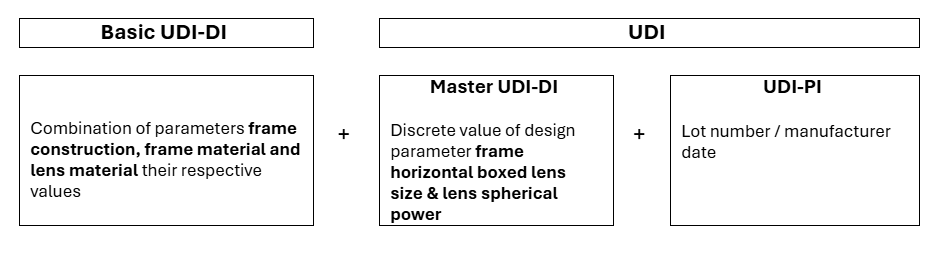
3. Ready-to-Wear Reading Spectacles
- Basic UDI-DI assignment is based on:
- Frame construction: full-rim, half-rim, rimless, or other types
- Frame material: metal, plastic, combination, or other types
- Lens material: mineral, organic (including polycarbonate)
- Master UDI-DI assignment is based on:
- Horizontal boxed lens size: discrete values typically between 40–60 mm
- Lens spherical power: discrete values in the range +1.00 D to +3.50 D (assignment triggers)
Each unique combination requires a distinct Master UDI-DI.
Labeling Requirements
For all three device types:
- The Master UDI-DI + UDI-PI must be included on the device labeling.
- The UDI carrier must meet MDR and issuing entity specifications (e.g., GS1).
- Non-binding sample label formats are provided in MDCG 2025-8.
Packaging Considerations
- Higher-level packaging used only for transport does not require a Master UDI-DI.
- If a multi-unit sales package contains multiple devices with the same Master UDI-DI, a Master UDI-DI may be required for that packaging level.
Vigilance Reporting
In the event of a serious incident, manufacturers must report:
- Master UDI-DI
- UDI-PI
Because a Master UDI-DI may cover a wide range of devices, manufacturers must maintain strict internal traceability to identify the specific devices involved.
Implementation Timeline
The new requirements take effect on 1 November 2028, following a three-year transition period that commenced after the entry into force on 13 October 2025.
Devices manufactured before 1 November 2028 do not need to bear a Master UDI-DI.
Note: Manufacturers are encouraged to implement the new requirements early to avoid delays in EUDAMED registrations and supply chain planning.
What This Means for Manufacturers
Manufacturers should:
- Analyse their product lines to determine appropriate Master UDI-DI groupings.
- Update labeling, product documentation, and packaging workflows.
- Prepare for EUDAMED UDI/Device registration under the amended MDR rules.
- Ensure internal traceability systems can support vigilance and PMS obligations.
How MedEnvoy Can Support
To help manufacturers navigate the new Master UDI-DI requirements, MedEnvoy offers targeted support across key regulatory and operational areas:
- Support regarding the correct Master UDI-DI groupings.
- Support labeling and packaging updates.
- Support EUDAMED device registrations.
- Monitor regulatory news and new EU guidance updates.
MedEnvoy offers expert regulatory support to manufacturers in navigating regulatory requirements. Our expertise ensures that your device meets the applicable standards, enabling safe ongoing compliance. We encourage you to contact our team for tailored support. Contact us so we can assist you.
Please see link to the MDCG 2025-8 Guidance here.
Related Guidance
We share our expertise because we believe in removing barriers to global commercialization.

How to Submit Data to swissdamed and How It Differs from EUDAMED
For years, the European medical device market operated under the assumption of seamless cross-border trade, supported by the…

COFEPRIS Finalizes Medical Device Labeling Standard
On May 19, COFEPRIS published an updated medical device labeling standard, NOM-137-SSA1-2025, in the official Diario Oficial de la Federación (DOF). The update replaces…

Swissmedic Launches 2026 PMS Focus Campaign for Higher-Risk Medical Devices
Swissmedic has issued a formal information letter announcing that it will conduct a focus campaign in 2026 reviewing…